Seamless Application Scaling Starts with AWS Elastic Load Balancing
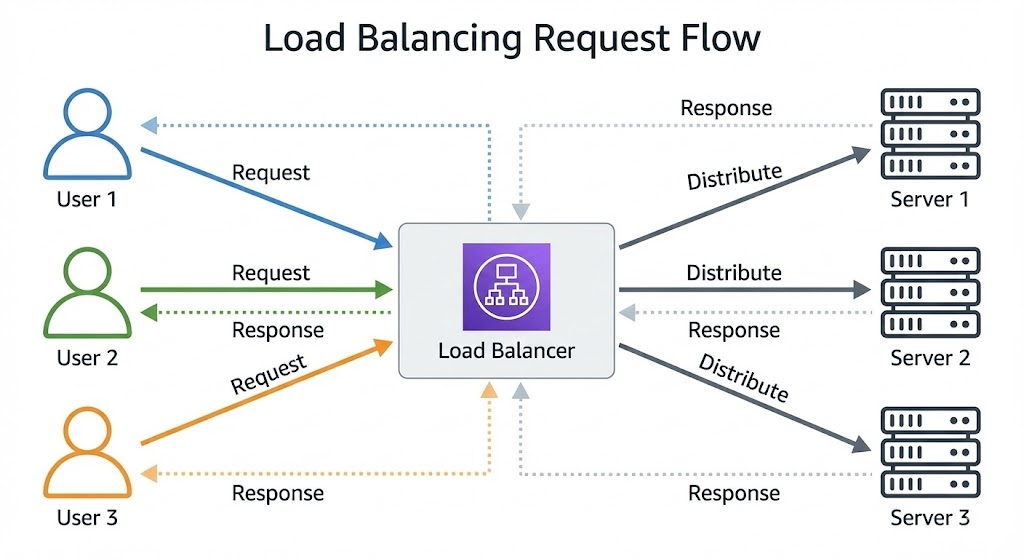
Basic Overview
Load balancing is one of the most important thing to maintain an application so that in a situation when there is a lot of traffic, the application doesn’t crash and the business doesn’t get disrupted.
More specifically load balancers are servers that forward internet traffic to multiple servers (EC2 Instances) downstream.
ELB (Elastic Load Balancer)
An ELB (Elastic Load Balancer) is a managed load balancer . And it is managed , maintained and upgrade by AWS. It costs less to setup your own load balancer but it will be a lot more effort on your end (maintenance, integrations)
Types of ELB
There are 4 types actually!
- Application Load Balancer (ALB)
- Network Load Balancer (NLB)
- Gateway Load Balancer (GWLB)
- Classic Load Balancer (retired in 2023)

Scalability Vs High Availability

Vertical Scaling: Increase instance size (= scale up / down)
- From: t3.micro – 1 vCPU, 1 GiB RAM
- To: m7i.32xlarge – 128 vCPUs, 512 GiB RAM
Horizontal Scaling: Increase number of instances (= scale out / in)
- Auto Scaling Group
- Load Balancer
High Availability: Run instances for the same application across multiple AZs
- Auto Scaling Group (multi-AZ)
- Load Balancer (multi-AZ)
What’s an Auto Scaling Group?
In real-life, the load on our websites and application can change. In the cloud, we can create and get rid of servers very quickly by using ASG (Auto Scaling Group).
An Auto Scaling Group automatically adjusts EC2 capacity based on load, maintains minimum–maximum instance counts, registers instances with the load balancer, and replaces unhealthy ones.

Scaling Strategies
Manual Scaling: Update the size of an ASG manually.
Dynamic Scaling : automatically adjusts capacity using Simple/Step rules triggered by CloudWatch alarms, Target Tracking to maintain a desired metric, and Scheduled Scaling to anticipate predictable usage patterns.
Predictive Scaling: uses machine learning to forecast future traffic and automatically provision the right number of EC2 instances in advance, especially useful for workloads with predictable time-based patterns.
